Abstract
In 1859, Charles Darwin published his landmark work, On the Origin of Species. Although his insights fundamentally altered the intellectual landscape, the perception of Darwin in contemporary popular culture differs substantially from his original writings. Darwin did not argue that species transition into one another spontaneously and randomly; rather, he described a typological and morphological affinity. Influenced by Georges Cuvier, he operated on the premise of the basic stability of species, asserting that natural selection acts exclusively on secondary adaptations (micro-mutations). Adhering to the adage “Natura non facit saltus”, he acknowledged that nature cannot autonomously execute a qualitative speciation jump; a transition to a higher level of organization requires divine guidance through a unique transitional form (‘the link’).
In the twentieth century, Neo-Darwinists linked Darwin’s name to a materialist and atheist worldview that reduced life to a blind process of chance and necessity. This article demonstrates how Neo-Darwinism co-opted and reinterpreted the historical Darwin. Furthermore, it addresses the theological consequences of this reduction and shows how empirical historical facts and modern genetics align more closely with the concept of a structured, mediate creation (creatio mediata).
I. Darwin and “On the Origin of Species”
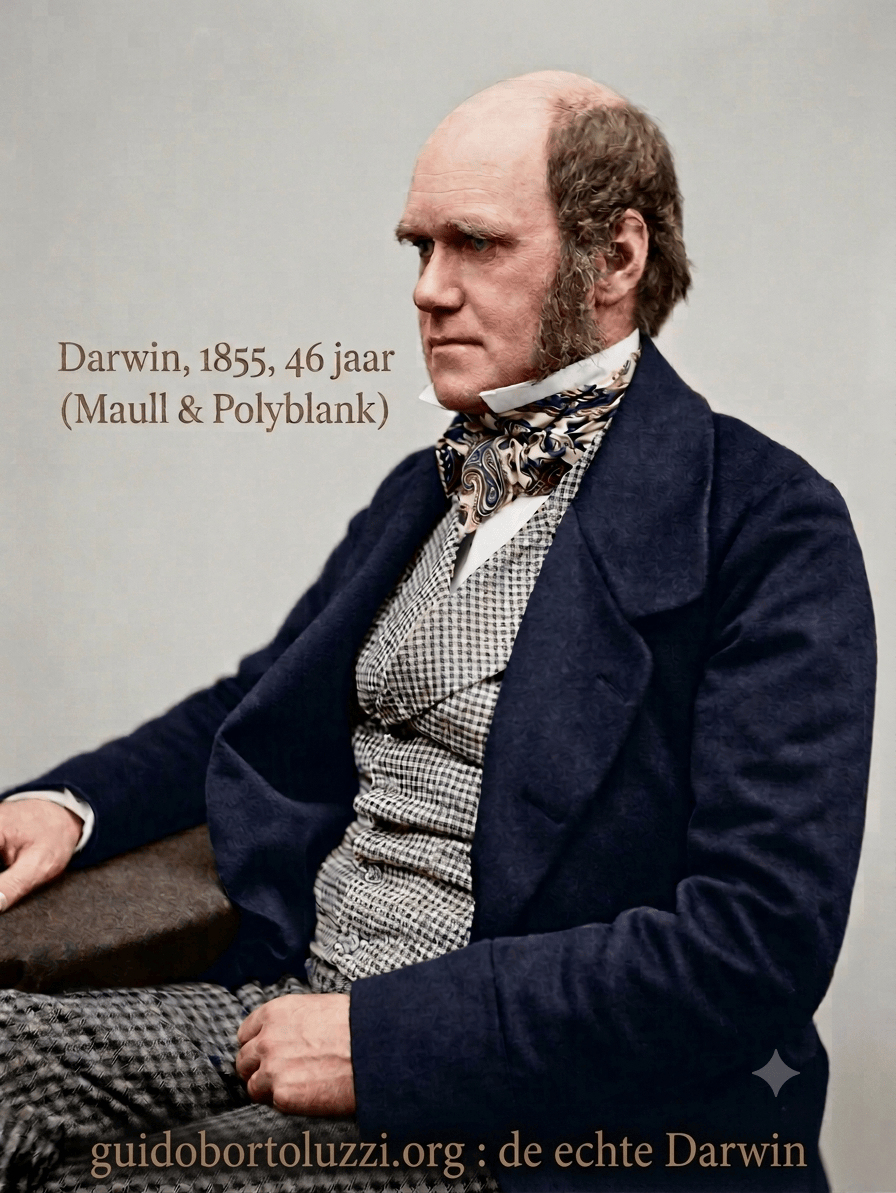
In the middle of the nineteenth century (1859), Charles Darwin’s masterpiece, On the Origin of Species, was published. His studies and deductions fundamentally disrupted the intellectual climate of his century and subsequent eras. What is presented in this treatise on Darwin will surprise many readers—particularly those who have read biographies or popular reviews of his work in good faith. To understand the historical Darwin in his true context, one must consider his entire body of work and line of thought.
Based on observations of countless organisms existing in nature, Darwin renewed a concept regarding phylogenesis previously formulated by the French naturalist J.B. Lamarck: the assumption of a common lineage or ordering for living beings. Darwin posited that in nature, a more complex species ‘derives from’ (deriva) a less complex species. At the apex of this phylogenetic series stands man, who ‘derives from’ the ape.
A crucial distinction must be made here: Darwin uses the term ‘derive from’ (deriveren) and explicitly not ‘descend from’ in the sense of a continuous, gradual process of change. This distinction is essential. Where ‘descent’ in the later Neo-Darwinian sense implies an unbroken continuity of slow, random, and cumulative transformations that gradually turn one species into another, ‘derive from’ in Darwin’s original conception merely indicates belonging to the same morphological class or taxonomic group. It expresses a typological derivation and analogy, not a mechanical, accidental self-transformation.
               [ HIERARCHY OF PHYLOGENESIS ]

                  Man (Complex / Superior)
                             ▲
                             │  [ "Speciation Jump" / Creatio Mediata ]
                             │  (Facilitated via the 'Bridgehead')
                             │
                  Ape  (Less complex)
His analysis was necessarily limited to deductions based on macroscopic and anatomical observation; genetic and molecular mechanisms were, after all, completely unknown in his day. Darwin restricted himself to describing morphological affinities, with the tropical organisms he observed during his voyages aboard HMS Beagle (including those in the Galápagos Islands) serving as his primary comparative material.
Darwin harbored great admiration for the French anatomist and paleontologist Georges Cuvier (1769–1832), the founder of comparative anatomy. Through fossil research, Cuvier had established that species in geological strata remain remarkably constant over immense periods of time, varying at most in secondary details or size. On this basis, Cuvier formulated his principle of the ‘fixity’ (immutability) of species.
In line with this concept of fixity, Darwin recognized basic species in a sense as bounded entities. The variations observed within a species pertain exclusively to secondary adaptations—what we today refer to as ‘micro-mutations’.
Regarding the transition between major species, Darwin demonstrated a keen intuition: the transition from an existing species to a new, higher level of organization requires a qualitative leap. Because nature of itself lacks the capacity to breach the intrinsic specific boundaries of a species, such a qualitative transition presupposes creative intervention. The transition takes place via a selected female individual of the pre-existing species. To designate this unique female progenitor through whom the qualitative renewal occurs, the term ‘link’ (anello di congiunzione / missing link) was introduced.
| Term | Meaning within the Synthesis |
|---|---|
| Micro-mutation | Adaptation within the boundaries of the species. |
| Macro-mutation / Jump | Qualitative transition to a new species. |
| The ‘Link’ | The physical substrate / “Bridgehead”. |
This ‘link’ is unique and transitional as such, which is why it cannot be found in the fossil record as a permanent population. The intrinsic meaning of the concept of the ‘link’ as a specific instrument of passage excludes the idea of a slow, spontaneous, and accidental accumulation of mutations, pointing instead to an ordered, purposeful process.
Darwin therefore did not consider that there was a purely mechanical, accidental transformation of one species into another in nature. Against the backdrop of natural laws, he referred to the well-known maxim:
“Natura non facit saltus” (Nature does not make leaps)
This emphasizes that nature of itself (ex propriis viribus) does not possess the capacity to autonomously cross the threshold to a higher species. If nature is not the causal source of qualitative speciation leaps, the order observed in phylogenesis points to the Author of the laws of nature: God the Creator.
Phylogenesis displays a progression in complexity in the order in which organisms appear, but it provides no proof of an unguided, spontaneous transmutation originating from nature itself. The merit of this view lies in recognizing the ordered phylogenetic line from the initial phases of creation up to the appearance of man. Subsequent insights from genetics and specific revelations from Catholic exegetical tradition (as elaborated in the writings surrounding Don Guido) clarify this principle.
Darwin’s second major observation concerns the mechanism of natural selection: he observed that secondary variations (micro-mutations) that provide an advantage in a specific environment are preserved, whereas less favorable variants disappear. Environment and selection act upon variability within the boundaries of the species. However, these adaptive micro-mutations must not be confused with qualitative macro-leaps representing a new genetic level of organization.
In summary: nature is inherently incapable of crossing fundamental species boundaries. Contrary to the portrayal often found in modern popular science publications, the historical Darwin cannot simply be equated with later, reduced materialist evolutionism. He retained an insight into the bounded nature of biological species and presupposed a higher ordering behind the origin of human nature. This approach aligns with the theological concept of creatio mediata (mediate creation), wherein God acts creatively through and within the existing natural substrate.
Contrary to popular belief, Darwin adhered to a personal theistic awareness. In his later years, he emphasized that it had never been his intention to undermine the foundations of religious faith or Sacred Scripture. He maintained his reverence for the Creator and received an honorable Christian burial upon his death.
With the discovery of the structure of DNA beginning in 1953 and the subsequent deciphering of the genetic code, it became clear that biological information possesses a highly complex, coded structure. In the theological synthesis of Don Guido, the concept of the ‘link’ is refined into the concept of the ‘bridgehead’ (capo di ponte): the biological substrate utilized by God to infuse a new, higher order.
II. Neo-Darwinism and Evolutionism
It was the later Neo-Darwinists, driven by a predominantly materialist and atheist philosophy, who linked Darwin’s name to an all-encompassing philosophical system. They redefined the concept of ‘evolution’ to mean:
“A continuous, spontaneous, and unguided natural process of change among species.”
They viewed biological species as being in a state of permanent, fluid, accidental ‘becoming’. The adage “Natura non facit saltus” was reinterpreted by them in a mechanistic sense: there are no qualitative leaps or creative interventions, only an unbroken chain of accidental mutations that, if useful, are preserved and transmitted by natural selection.
| Current | Core Principle |
|---|---|
| Historical Darwin (according to the Synthesis) | Fixed species; qualitative transition via divine ordering/institution (‘link’). |
| Neo-Darwinism | Accidental mutations + natural selection; continuous and unguided process without a Creator. |
| Theistic Evolutionism / Teo-evoluzionismo | God merely provides an ‘initial input’; the universe subsequently evolves autonomously. |
According to the Neo-Darwinian paradigm, all biological structures and species arise exclusively through the interplay of chance (il caso) and necessity (environmental selection). This marks a fundamental break with the classical phylogenetic view of guided ordering.
However, paleontological and biological facts demonstrate that numerous organisms—such as ants, sharks, and coelacanths—have remained morphologically virtually unchanged over hundreds of millions of years. Man, by contrast, exhibits a unique history. Within the theological synthesis of Revelation, it is clarified that morphological degeneration and changes in human history are not the result of an upward spontaneous evolution, but of a phylogenetic hybridization (involution), followed by a God-guided and sustained process of restoration (ri-evoluzione).
Materialist Neo-Darwinism was employed during the era of Positivism as an ideological tool to replace belief in creation with a purely naturalistic worldview. In doing so, Judeo-Christian doctrine—which confesses God as the direct Author and Sustainer of creation—was set aside.
This materialist reduction also influenced theological thinkers in the twentieth century. A prominent example is the French Jesuit and paleontologist Pierre Teilhard de Chardin (1881–1955), who formulated the theory of ‘guided evolution’. Many theologians saw in this an attractive compromise between modern natural science and faith. However, this approach was forcefully criticized by Don Guido, as the concept of guided spontaneous evolution implied the loss of God’s direct act of creation.
In later decades, authors and scientists—such as the geneticist Francis Collins (author of The Language of God)—have attempted to bridge the gap between faith and genetics. However, when one adheres to the premise that nature can autonomously transform itself from one species into another, one remains stuck in the assumptions of theistic evolutionism (teo-evoluzionismo).
According to theistic evolutionism, God supposedly gave an ‘initial impulse’ at the beginning of the universe, after which the creative process developed autonomously and spontaneously. This view reduces the Creator to a passive bystander and stands in tension with Judeo-Christian doctrine, in which the entirety of created reality is sustained and established moment by moment by the active, loving Will of God (creatio continua).
Attributing the origin of complex biological order to mere ‘chance’ harks back to ancient materialist philosophy. Dante Alighieri placed the philosopher Democritus in his Inferno (Canto IV) with the characteristic description:
“Democrito, che ‘l mondo a caso pone”
(Democritus, who ascribes the world to chance)
Accepting a completely spontaneous, unguided evolution undermines the central pillars of Christian dogmatics:
- Creatio ex nihilo (Creation out of nothing): Confessing that energy, matter, the universe, life, and the specific nature of man (Male and Female) were directly willed and established by God.
- The Original State and the Fall: The principle of the creation of man in a state of original integrity, the subsequent Fall (with its biological and spiritual consequences for posterity), and the absolute necessity of Redemption through Jesus Christ.
If man were the product of a purely autonomous, upward self-evolution, the concept of the ‘Fall’ and the necessity of redemption would lose their theological meaning. In that system, God would no longer be the necessary Origin and Redeemer, but merely a human projection. The theological synthesis, by contrast, restores the balance: it acknowledges the scientific facts of genetics while unreservedly upholding the sovereign, creative, and guiding Act of God in the history of life.
References
- Darwin, Charles. On the Origin of Species by Means of Natural Selection. London: John Murray, 1859.
- Cuvier, Georges. Recherches sur les ossemens fossiles de quadrupèdes. Paris, 1812. (For Cuvier’s principle of the fixity of anatomical types).
- Alighieri, Dante. La Divina Commedia, Inferno, Canto IV, v. 136.
- Teilhard de Chardin, Pierre. Le Phénomène Humain. Paris: Éditions du Seuil, 1955.
- Collins, Francis S. The Language of God: A Scientist Presents Evidence for Belief. New York: Free Press, 2006.
Father J. Geudens, Smakt, September 16, 2026, guidobortoluzzi.org

